

By Eddie Smith, MSU Extension Service
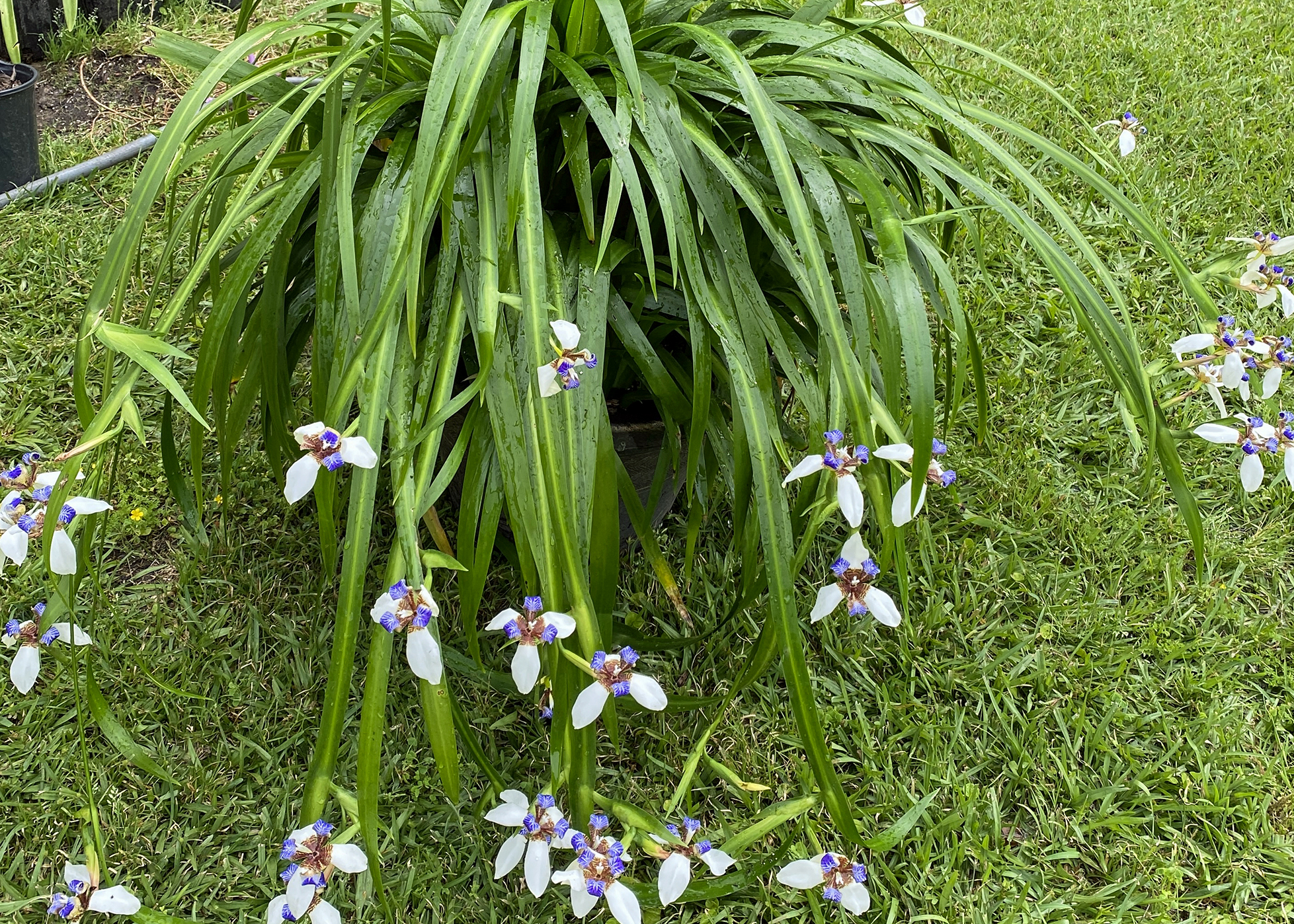
The walking iris has graceful, arching foliage and blooms that steal the show. (Photo by MSU Extension/Eddie Smith)
One of my treasured plants is the walking iris which I grow in a container. Every March, I look forward to its blooms as a sure sign that spring has arrived.
The walking iris earns its place in my landscape with its graceful, arching, sword-like foliage. But when it blooms, it truly steals the show.
The blooms are nothing short of spectacular and are often mistaken for orchids. Each flower lasts only a single day, which makes catching it at its peak feel special, almost like a reward for paying attention.
Flowers are made up of six petal-like segments arranged in a bold, architectural form. It is impossible to walk by these beautiful flowers without stopping to admire them.
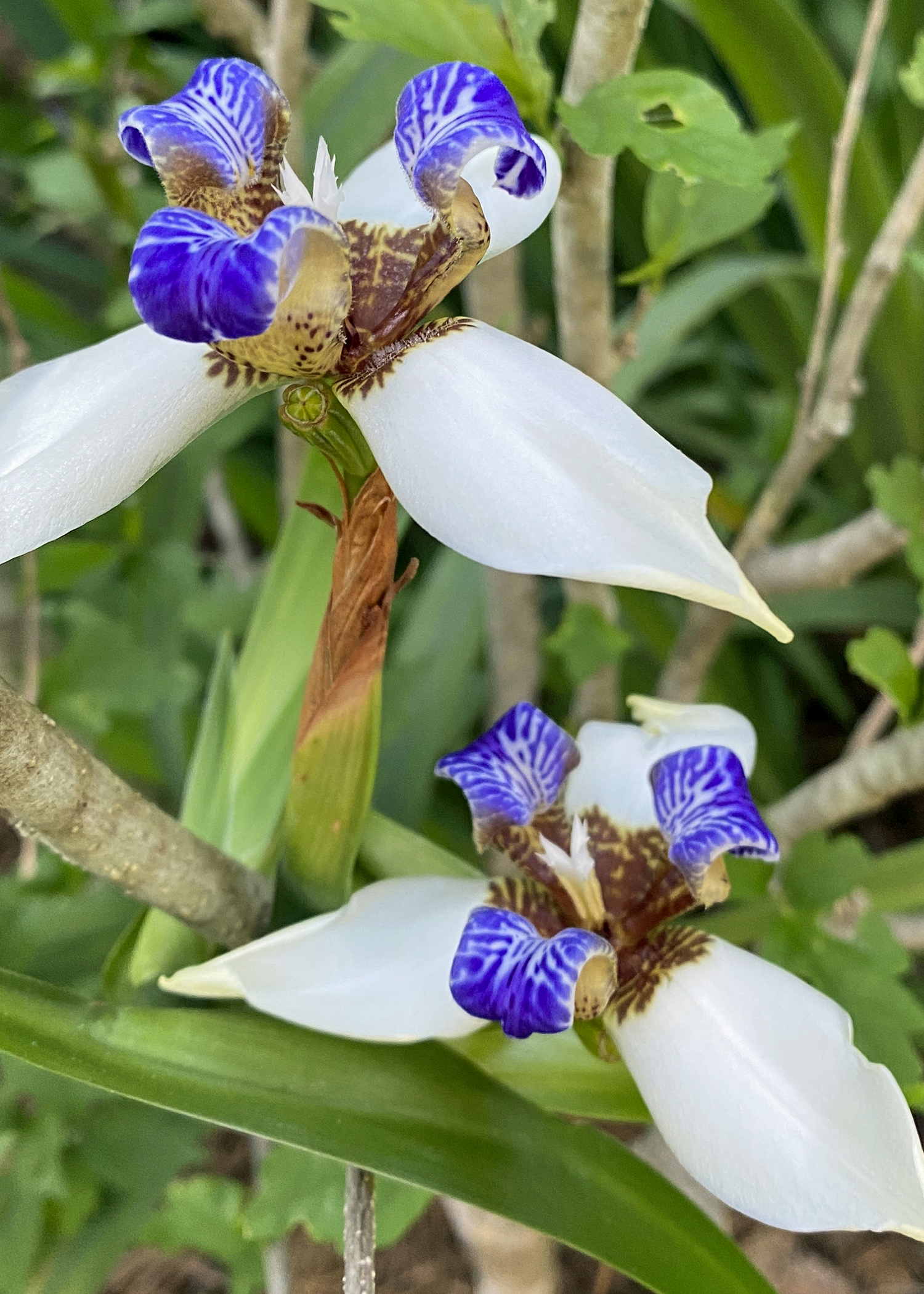
The blooms of walking iris are often mistaken for orchids and only last a single day. (Photo by MSU Extension/Eddie Smith)
The three outer petals are a bright, luminous white, broad and smooth, gently drooping and tapering at the tips. They provide the perfect backdrop for the three upright inner petals, which are rich shades of violet to deep blue and finely marked with crisp white striping that looks hand-painted.
At the base of these inner petals are warm tones of bronze and chocolate brown, patterned in intricate markings that give the flower incredible depth and character. The center of the bloom is layered and sculptural.
I grow my walking iris in a container as it allows me to place the plant where it can be enjoyed up close. I can also easily move it, if needed.
Known scientifically as Neomarica, the walking iris is commonly found in U.S. Department of Agriculture Hardiness Zones 8B–11, but container growing adds even more flexibility.
My plant performs best in part sun to light shade where it receives bright light without harsh afternoon sun. Watering is key, especially in a container, and I start with a well-drained potting mix.
I make sure the container never stays soggy, and I also avoid letting it dry out completely. If it dries too much, the leaf tips brown and droop, so I water regularly to keep the soil evenly moist.
A light application of a balanced fertilizer in late winter or early spring helps support strong growth and encourages blooming.
Maintenance is minimal. I usually leave the spent flower stalks in place as new plantlets are forming, which is part of the fun and the reason behind the name “walking iris.”
These plantlets appear at the tips of spent flower stalks. As they grow, the stalks gradually bend under their own weight until it touches the soil, where the plantlet can take root.
In a container, I sometimes allow the plant to naturally “walk” around the pot, or I gently cut the plantlet and pot it on its own. This is an easy and satisfying way to propagate new plants and share them with friends.
Another reason I love this plant is how well it transitions indoors.
When needed, my container-grown walking iris makes an excellent houseplant. I keep it in a bright window out of direct sunlight and continue regular watering.
Whether growing in my landscape or indoors, the walking iris has become a favorite reliable and beautiful plant I look forward to enjoying every spring.
[EDITOR’S NOTE: Dr. Eddie Smith is a gardening specialist and Pearl River County coordinator with the Mississippi State University Extension Service. He is also host of the popular Southern Gardening television program. Locate Southern Gardening products online at http://extension.msstate.edu/