

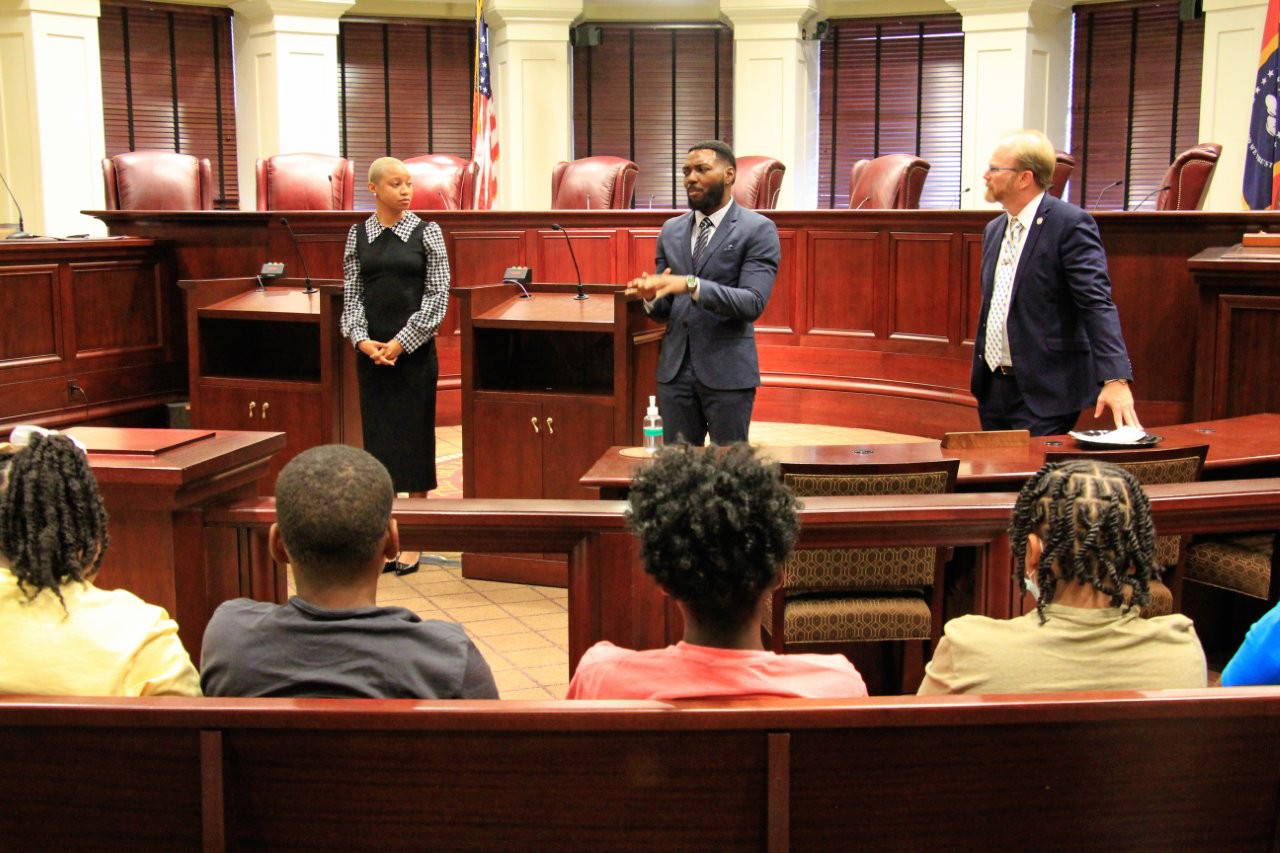
Attorney Demarcus McGee, standing, center, talks to fifth graders about his work as a corporate defense lawyer during a Constitution Day program on Sept. 16 at the Mississippi Court of Appeals. Special Assistant Attorney General La’Bria Barnes is standing, at left, and Court of Appeals Judge David Neil McCarty is standing at right.
Twenty-eight Jackson fifth graders enthusiastically banged a gavel and quizzed their peers like aspiring lawyers and judges during a visit to the Mississippi Court of Appeals on Sept. 16.
The field trip to the court was a celebration of Constitution Day, which is actually observed this year on Sept. 17. Operation Shoestring’s after school program coordinated the visit with Court of Appeals Judge David Neil McCarty. Students attend Jackson’s Galloway and Walton Elementary Schools.
The first of two groups of students had barely sat down in the courtroom before a student asked, “Can we go to kangaroo court?” Judge McCarty explained that the Court of Appeals is rooted in fairness. Another student asked, “What are appeals?” Appeals are a legal process that allows a group of judges to review what happened in another court. Then someone asked about Judge Judy. “She’s rich and I’m not,” Judge McCarty said. “Judge Judy is a TV character.”
Judge McCarty explained the makeup of the Court of Appeals: ten judges, five women and five men. “Everyone in this room can be a lawyer. Everyone in this room can be a judge,” he told the students. “You belong here. I get to work here, but this belongs to you.”
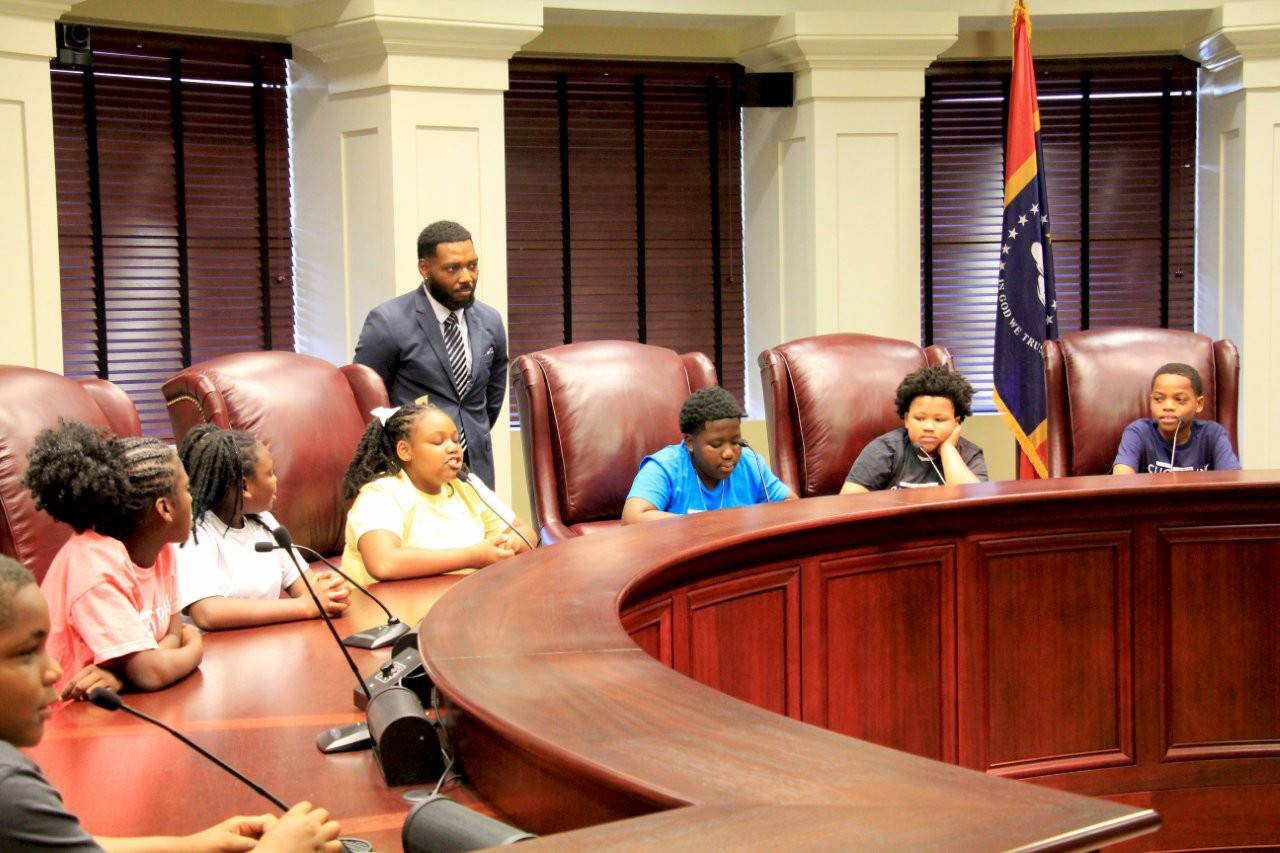
Attorney Demarcus McGee, standing, listens as a student speaks as a judge during a Sept. 16 Constitution Day program at the Mississippi Court of Appeals.
He explained before students arrived, “Most people never go to a courtroom except on days when the stakes are very high. We want these students to see the courtroom not as a place of confrontation or fear, but a place where they belong, where they see themselves as attorneys and judges.”
Asked to name the three branches of government, some of the students answered in unison: executive, legislative and judicial.
The students have been studying civics this week in their after-school program, said Operation Shoestring Development and Volunteer Coordinator Molly McMillan. Without civics currently being taught in schools, “this is crucial to their understanding of how society operates.”
The field trip brought the classroom to the courtroom. Teacher Charles Thurman said, “They get a snapshot of what the judicial system is all about, what is required to hold those positions and what is expected of those who hold those positions.”
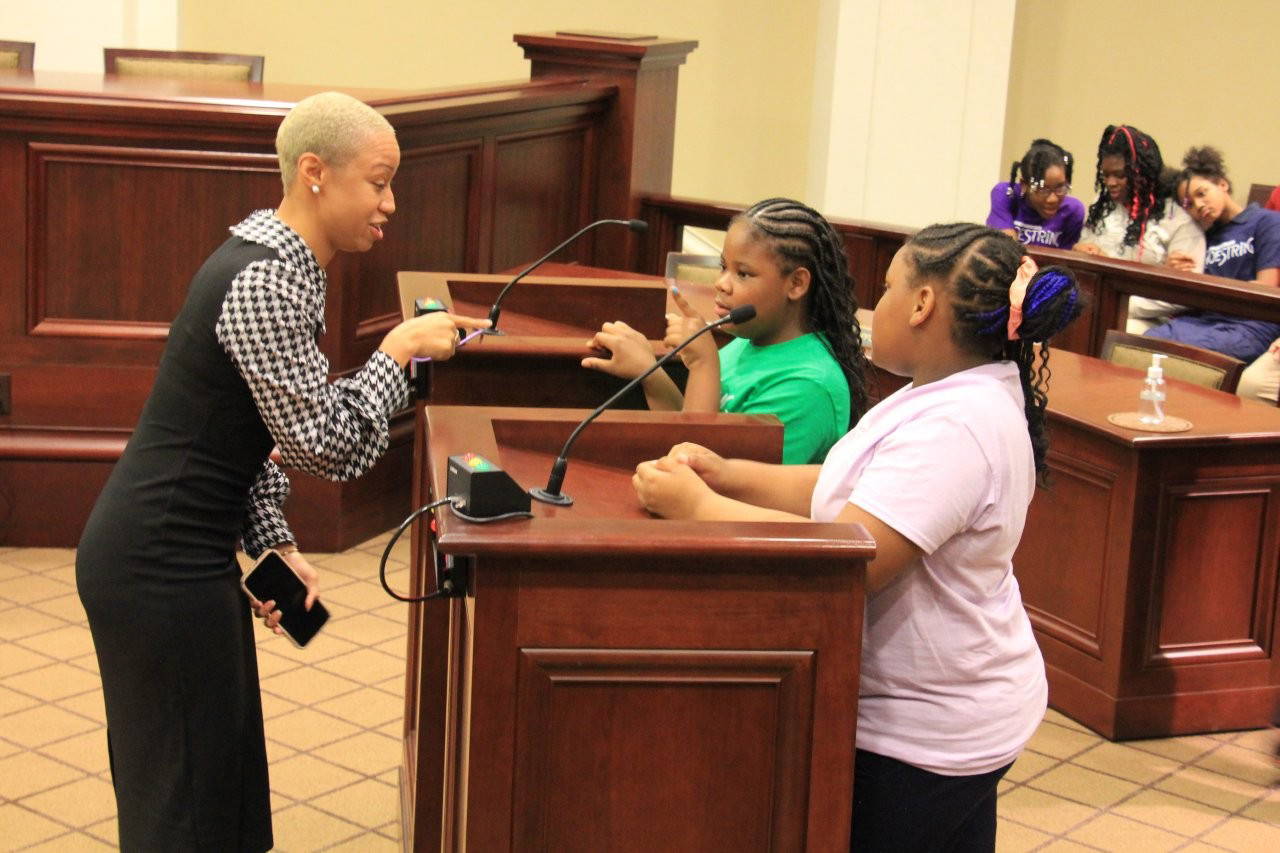
Special Assistant Attorney General La’Bria Barnes talks to two students before they make their case presentations during a Sept. 16 Constitution Day program at the Mississippi Court of Appeals.
Special Assistant Attorney General La’Bria Barnes and attorney Demarcus McGee explained their backgrounds, education and a little bit about their work. Barnes represents boards and commissions. McGee defends corporations in civil litigation. Then they gave elementary explanations of First Amendment guarantees of freedom of religion and free speech.
Barnes asked students their favorite foods, and was met with shouted responses of seafood, wings, pizza, pasta, burgers and fries. “What if I told you that everyone had to eat the same thing at the same time?” she continued. As with different food preferences, people worship differently. “All of us are different and you do have a right to how you pray, who you pray to, and whether you pray at all,” she said.
McGee told students to imagine free speech like a bubble. “You can’t do something in your bubble that affects someone else’s bubble. We have the freedom to speak what we want to speak, say what we want to say.” But there are limits. For instance, “It can’t incite violence. It can’t be defamation.” He went on to give an example of deliberately making false statements to harm a competitors’s business.
Judge McCarty explained Sixth Amendment rights to legal representation. “If you are accused of a crime, you have the right to have someone to protect you.” He said, “Even if you did something wrong, you still want to treat people fairly.”
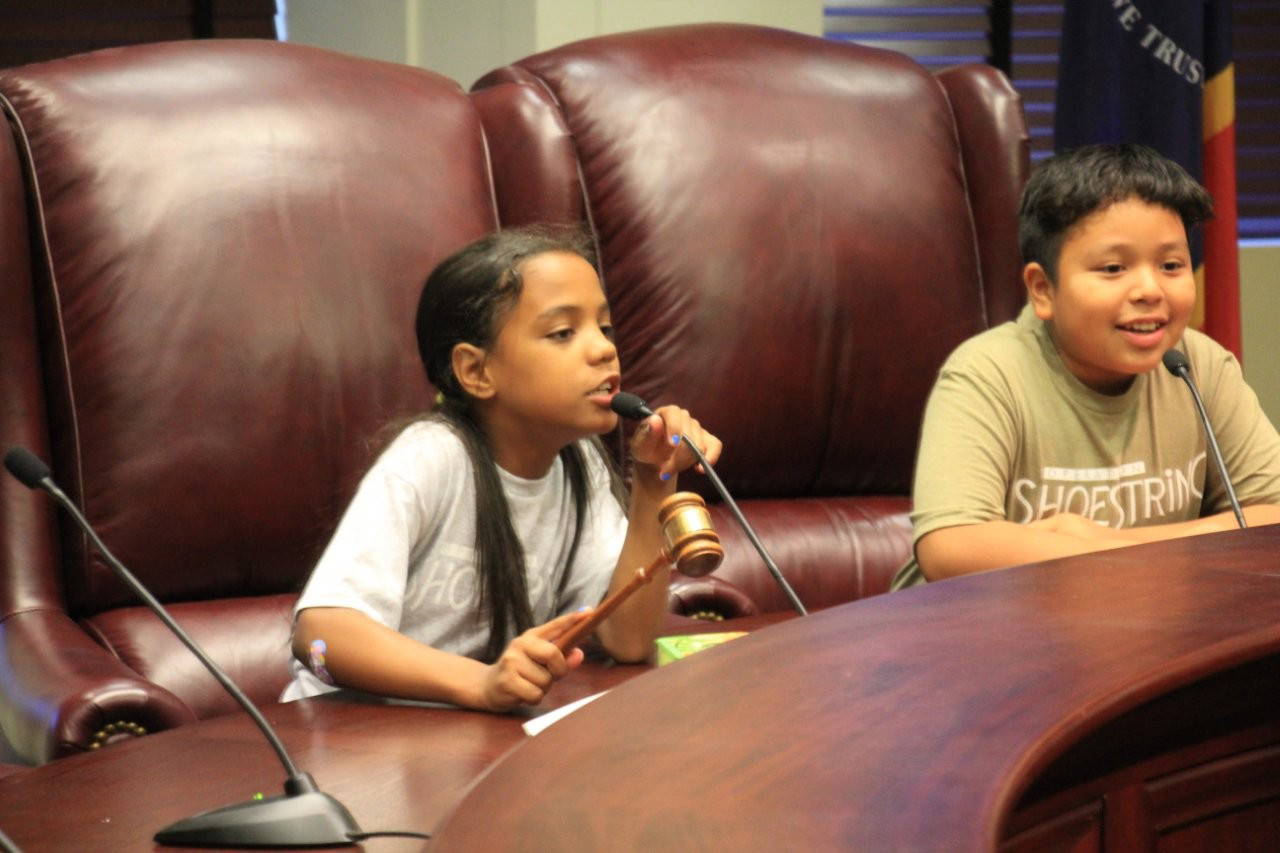
A student, at left, raps the gavel as she calls for “order in the court.”
Then students did some role playing. Hands flew up and students scrambled to the podium and the bench to prosecute, defend and judge. Several hastily-formulated assault trial scenarios played out quickly among enthusiastic and noisy participants. One was about a scuffle at a grocery store meat counter. The victim said that the defendant assaulted her. “I need justice!” someone exclaimed. A female student at the bench rapped the gavel, barking “Order in the court!” over the din. Then she said, “Now I need to hear his perspective.” The defendant blurted out, “It was the last turkey!” and admitted that he tried to take it by force. A court observer interjected a defense: the Fifth Amendment right against self-incrimination.
The hosts wrapped up the visit with gift bags that included mini copies of the U.S. Constitution, flags and other goodies.
On Sept. 17, 1787, delegates to the Constitutional Convention signed the U.S. Constitution in Philadelphia, Pennsylvania