
By Jeremy Pittari, Magnolia Tribune
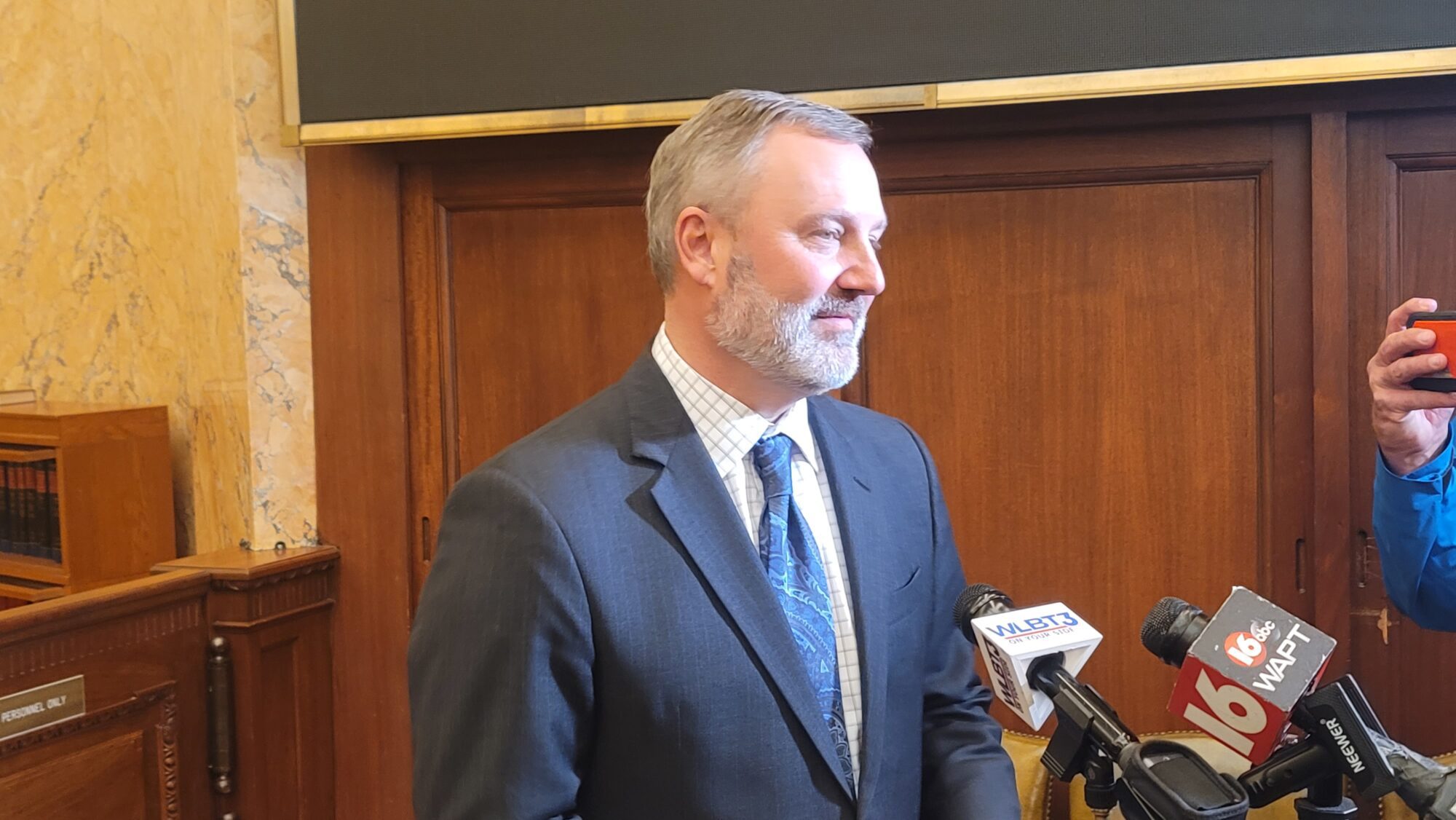
Speaker of the House Jason White addresses the media on Wednesday after Lt. Gov. Delbert Hosemann announced the Senate’s new tax plan. He also discussed the expected death of a school choice bill in the House. Photo by Jeremy Pittari | Magnolia Tribune
Pharmacy benefit manager reform within Mississippi has been a hot topic during legislative sessions for the past several years, but the Senate and House of Representatives have yet to come to an agreement on the steps necessary to address concerns.
This session, only the House introduced a bill to take the matter up, with State Rep. Hank Zuber (R) authoring HB 1665. In its original form, it included provisions that prevented PBMs from steering patients towards their affiliate pharmacies, a change independent pharmacies have requested.
Last week, a Senate committee adopted a strike-all amendment to that bill that removed the steering prohibition and added a reverse repealer to keep discussions ongoing as lawmakers debate the reforms. On Tuesday of this week, the full Senate took up a revised version of that strike-all that removed the reverse repealer in a move State Senator Rita Parks (R) stated would provide the House with a clean bill to allow it to move to the governor’s desk if the House concurred.
Speaker Jason White (R) told Magnolia Tribune Thursday that leadership in the House are reviewing the Senate changes.
“We’re in the process of evaluating what the Senate included in their strike-all amendment to HB 1665. Our initial concern is the removal of the anti-steering language, which has long been requested by independent pharmacists,” White said.
Senator Parks said last week that the independent pharmacies agreed to the removal of steering prohibition in exchange for higher filling fees. Parks believes that change will help keep the state’s independent pharmacies open.
“What this bill does, especially those in our small rural communities, it’s continuing their access to healthcare,” Parks said while on the Senate floor Tuesday. “It’s our constituents that don’t have access to physicians in the small towns or maybe that they can’t afford.”
Since 2001, about 55 independent pharmacies have closed, Parks said.
Also included in her strike-all amendment is a requirement for Pharmacy Service Administrative Organizations to be licensed.
“They are an intermediate representing the independent pharmacist,” Parks described.
Other provisions include increased transparency into PBMs and their pricing structures, and ensuring independent pharmacies are reimbursed at the same rates as PBM affiliate pharmacies, to name a few.
State Senator Jeremy England (R) disagreed with the amended version of the bill, stating that the House’s version is what independent pharmacists asked for, and the Senate’s version of the bill will only increase costs to the state through the increased filling fees.
“I agree we should send a clean bill to the House to vote on. I think we should have concurred on their bill, HB 1665,” England said.
England claimed that the Senate strike-all amendment to HB 1665 would result in upwards of a $50 million impact to the State Health Insurance plan. England said there are between 800,000 to 2 million prescriptions currently covered under the state employee health plan.
However, Parks argues that leaving the bill as it came from the House would allow PBMs to keep the upper hand.
“[HB] 1665 gives PBMs the authority, and it gives them the authority to reimburse whatever and however they want to,” Parks said to England on the Senate floor. “Now is that what you want to do?”
State Senator Daniel Sparks (R) asked from where England got his cost increase estimates, saying, “I just want to make sure that your fiscal note was not prepared by PBMs.”
England said he asked the Legislative Budget Office for the fiscal note, adding that LBO had to contact the Department of Finance and Administration, who in turn had to contact the state’s health plan PBM. Sparks then added that the numbers provided to England suggesting a $50 million increase did not add up.
The Mississippi Business Alliance and its members also came out in opposition to the Senate strike-all amendment to HB 1665. The group said while their members have made a good-faith effort to work with the Legislature for the past three years and have supported meaningful legislation to support independent pharmacists, “We have been clear from the very beginning that we will oppose any legislation mandating an increase in dispensing fees.”
The Senate ultimately passed the amended version on HB 1665 by a vote of 44 to 7. It remains unclear whether the House will take up the Senate’s version.
“HB 1665, as it passed the House, had received support from independent pharmacists and Mississippi businesses,” Speaker White added. “It seems that after years of work on this issue, we had finally found the middle ground for real PBM reform that was not at the detriment of our state’s business community.”
White said his members would review the Senate’s strike-all amendment “through the lens of seeking relief for independent pharmacists who work hard to support Mississippi’s communities, while also evaluating the impact on businesses’ bottom line.”