

By Russ Latino, Magnolia Tribune
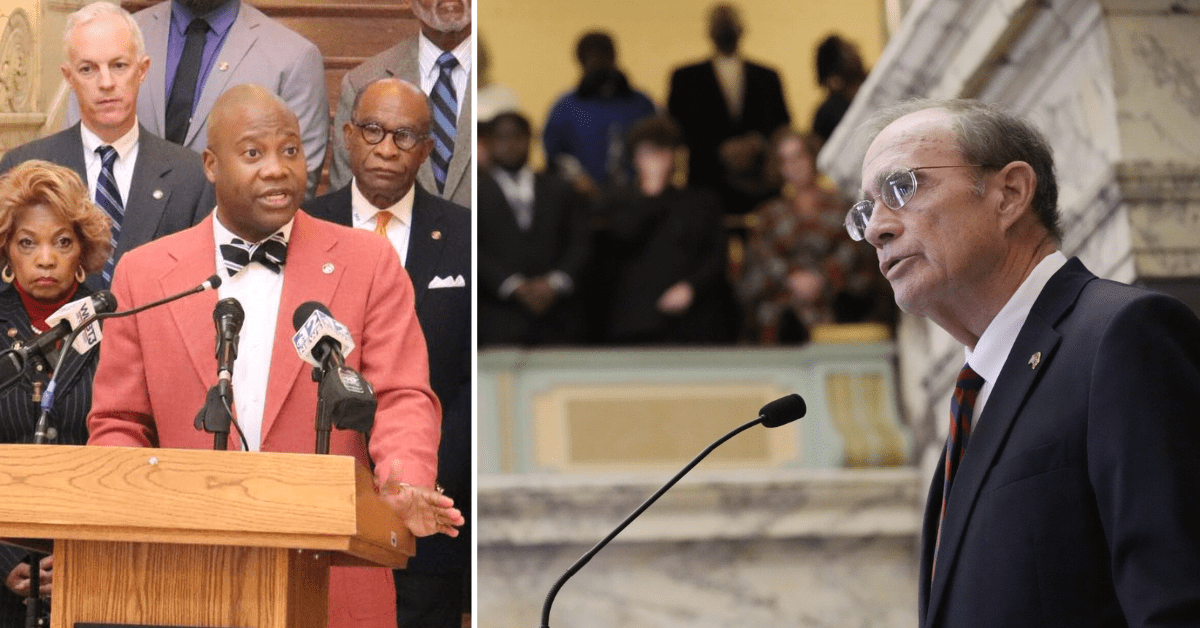
State Senator Derrick Simmons (from his Facebook) and Lt. Governor Delbert Hosemann (AP Photo/Rogelio V. Solis)
In 2025, U.S. District Judge Sharion Aycock ruled decades’ old judicial district lines, used for the election of the Mississippi Supreme Court, violate Section 2 of the Voting Rights Act. Among the plaintiffs in the suit — which argued that the existing North, Central and South judicial districts diluted Black voting strength — is Senate Minority Leader Derrick Simmons (D). Aycock ordered the Legislature to redraw the maps or else.
Lt. Governor Delbert Hosemann (R) recently named Simmons as one of three Senate conferees tasked with negotiating HB 1749, the House’s bill to overhaul the state’s Supreme Court map. This would place a lead litigant against the state at the center of the remedy process. He is joined by Republican Senators Brice Wiggins and Joey Fillingane as conferees. House conferees include State Representatives Kevin Horan, Jansen Owen and Joey Hood, all Republicans.
(Since original publication of this opinion column yesterday afternoon, Senator Simmons has been replaced as a conferee on HB 1749, according to Senator Brice Wiggins. Both Wiggins and Lt. Governor Delbert Hosemann said senators planned to use a separate vehicle, SB 2138 to enact Supreme Court redistricting and an agreement had been reached with the House. House conferee Kevin Horan subsequently denied an agreement being reached in a conversation with Magnolia Tribune.)
Judge Aycock’s ruling concluded that the state’s three Supreme Court districts were drawn in a way that prevents Black voters from having an equal opportunity to elect candidates of their choice.
Rather than impose a map herself, Aycock gave the Legislature the first opportunity to fix the violation. Lawmakers are now under pressure to produce a compliant plan during the 2026 session or risk a court-ordered map.
Aycock’s ruling comes at a time when the U.S. Supreme Court is actively deliberating a case that could prevent the use of race-based decisionmaking in how electoral maps are drawn.
White plaintiffs in Callais v. Louisiana have argued that Section 2 of the Voting Rights Act is an unconstitutional violation of the Fourteenth Amendment’s equal protection clause.
Additionally, there are cases percolating through the U.S. Court of Appeals challenging whether private citizens can sue under Section 2. In Arkansas State Conference NAACP v. Arkansas Board of Apportionment, the Eighth Circuit Court of Appeals found that citizens did not have a private cause of action and only the Department of Justice could sue under Section 2.
Either of these cases could prove fatal to the ACLU/Southern Poverty Law Center lawsuit.
Simmons, State Both in Precarious Position
Simmons found himself placed in a delicate position, arguably legally conflicted position — negotiating legislation that directly responds to a lawsuit in which he is a plaintiff. Basically, he was placed on both sides of the litigation. If he signed on to a plan with his fellow legislators, it might create legal arguments that could be used against his co-plaintiffs should they still object to the Legislature’s solution.
If he failed to sign on, it could create additional legal arguments against the state. One could reasonably assume he would not do anything to weaken the pending litigation to which he is a party.
The state is also in a precarious position. It has filed an appeal to the 5th Circuit Court of Appeals, but the appellate court is holding the case in abeyance pending the U.S. Supreme Court’s decision. The 5th Circuit has not, however, stayed Aycock’s decision in the interim, meaning that it remains in force.
The Legislature could redistrict the Supreme Court maps before they leave town to comply with Aycock’s ruling only to find out months later that the exercise was unnecessary because the U.S. Supreme Court invalidated Section 2, or separately, that it gets tossed for lack of judicial standing of the named plaintiffs.
But if the Legislature does nothing and the U.S. Supreme Court ultimately upholds Section 2 or the Fifth Circuit finds the plaintiffs had standing, Aycock may impose her own court-drawn map. Already her ruling is blocking judicial elections scheduled for November of this year pending a newly approved map.
That has already had real-world consequences. The court’s order disrupted the 2026 election cycle, preventing at least one sitting justice, David Ishee, from qualifying for reelection under the existing districts.
Addendum
After original publication of this column both Senator Wiggins and Lt. Governor Hosemann criticized it on social media.
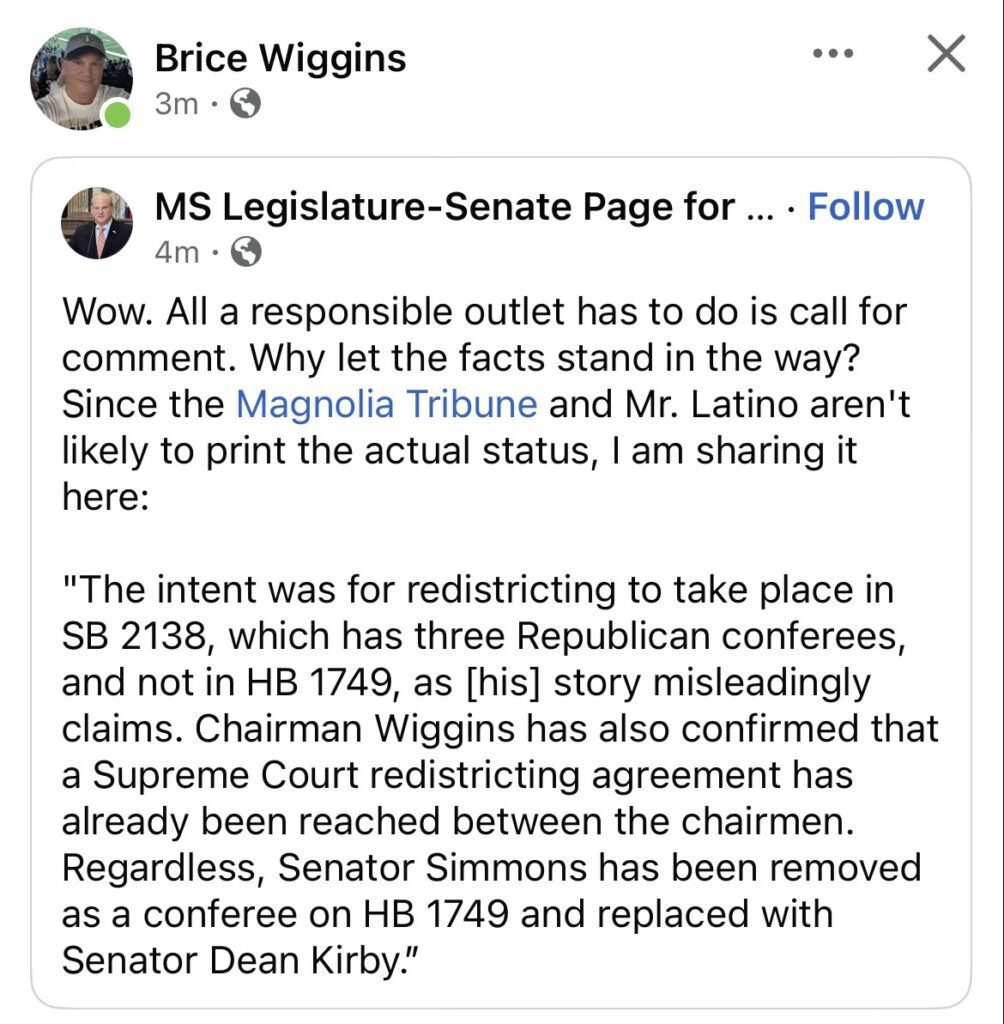
Hosemann, more tactfully, repeated the same point suggesting this author had the wrong bill and that an agreement had already been reached.
But ponder this: if the original opinion column was wrong, why remove Senator Simmons as a conferee on HB 1749 in response?
The facts remain. HB 1749 was the House’s version of Supreme Court redistricting, and as of yesterday afternoon, House leadership believed it to be the vehicle for changes. The bill is alive in conference and could be used this way. Senator Simmons was appointed to be a conferee on it, even though he’s a plaintiff in a lawsuit against the state on the matter. Representative Horan denied the existence of an agreement. Whether another legislative vehicle is ultimately used is somewhat irrelevant to the point.