
Tally Connelly, UMMC Communications
Photos By: Melanie Thortis/ UMMC Communications

Dr. Mitchell Hobbs, director of the pediatric hospital medicine fellowship program, begins morning rounds in the Batson Tower.
A growing pediatric specialty at the University of Mississippi Medical Center is reaching a new milestone with the addition of a fellowship program designed to train physicians in the care of hospitalized children.
The Division of Pediatric Hospital Medicine in the Department of Pediatrics has expanded its team and its role throughout Children’s of Mississippi in recent years. Now, UMMC has received accreditation from the Accreditation Council for Graduate Medical Education for a pediatric hospital medicine fellowship, creating a new opportunity to train physicians in the subspecialty without leaving Mississippi.
The two-year fellowship is expected to welcome its first fellows in July 2027, with plans to train two fellows per year.
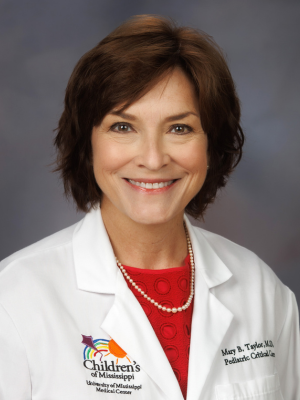
Dr. Mary Taylor
“This fellowship is an important milestone for our Department of Pediatrics and reflects the tremendous growth of our pediatric hospital medicine team,” said Dr. Mary Taylor, Suzan B. Thames Chair of Pediatrics and CEO of Children’s of Mississippi. “By training the next generation of pediatric hospitalists here in Mississippi, we are strengthening our workforce and building on our commitment to provide the highest level of care for children across our state.”
The fellowship builds on several years of growth within the Division of Pediatric Hospital Medicine.
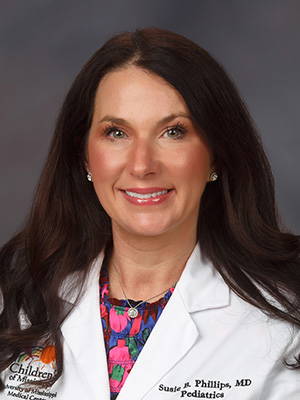
Dr. Sue Phillips
“We have expanded our footprint within the hospital, not only in terms of number of providers but also with our team structure,” Dr. Sue Phillips, chief of the Division of Pediatric Hospital Medicine said.
Pediatric hospitalists care for children who require inpatient medical treatment, following an evaluation by the pediatric emergency department. At the children’s hospital, the hospital medicine team admits general pediatric patients who require hospitalization, from children with common illnesses such as gastroenteritis and bronchiolitis to those with more complex medical needs.
The team also accepts direct admissions from physicians throughout Mississippi as well as transfers of children hospitalized elsewhere who need a higher level of care.
As the division has grown, its physicians have also increasingly worked alongside pediatric subspecialists and surgeons through co-management and consultation. Phillips said the growth has allowed the division to refine its team structure with education in mind.
Previously, one attending physician could cover two teams. The division has moved toward a structure that allows attending physicians to work more closely with individual teams, creating additional opportunities for resident education.
Education is also at the center of the division’s newest endeavor.
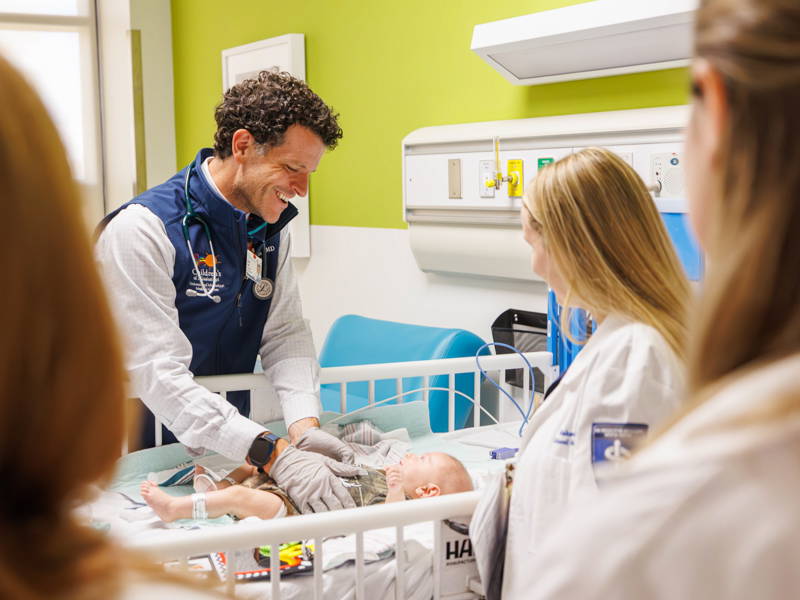
Hobbs and Makala Garner, medical student, evaluate Maverick Hopkins of Vicksburg during morning rounds in the Batson Tower.
Dr. Mitchell Hobbs, director of the pediatric hospital medicine fellowship program, said developing the fellowship required support from the Department of Pediatrics and a program capable of advancing UMMC’s missions of education, health care and research.
“It’s serving a need for our learners who have had to leave the state to receive this training,” Hobbs said. “It’s serving a need for the health care of Mississippi, because pediatric hospital care has grown increasingly complex and requires a lot of coordination because of advances in care and survival of kids with chronic conditions.”
Pediatric hospital medicine has existed as a field for years but has more recently developed into a board-certified pediatric subspecialty. Phillips said the increasing acuity and complexity of inpatient pediatric care has made the field attractive to physicians while expanding the hospitalist’s role beyond bedside care.
Quality improvement, education and evidence-based practice have become important components of the specialty as well.
For Phillips, adding fellows to the educational environment at Children’s of Mississippi will introduce another level of physician learners to a setting that already includes medical, pharmacy and other health professions students, residents and interns.
“When you’re training somebody to become a hospital medicine physician, it really ensures that you are as evidence-based and up-to-date as possible,” she said.
Fellows will train across the spectrum of pediatric hospital medicine, gaining experience in newborn care, intermediate neonatal intensive care, complex inpatient general pediatrics and community inpatient pediatrics. They will also receive training in intensive care, procedures, sedation, quality improvement and research methods.
The children’s hospital offers a particularly broad environment for that training, Hobbs said, because hospitalists work alongside pediatric subspecialists in caring for patients from throughout the state.
“We receive and care for the sickest children in the state,” Hobbs said. “We house every pediatric subspecialty needed to coordinate that care and work with them on a daily basis.”
The fellowship will also create a new pathway for physicians who want to pursue pediatric hospital medicine while remaining in Mississippi.
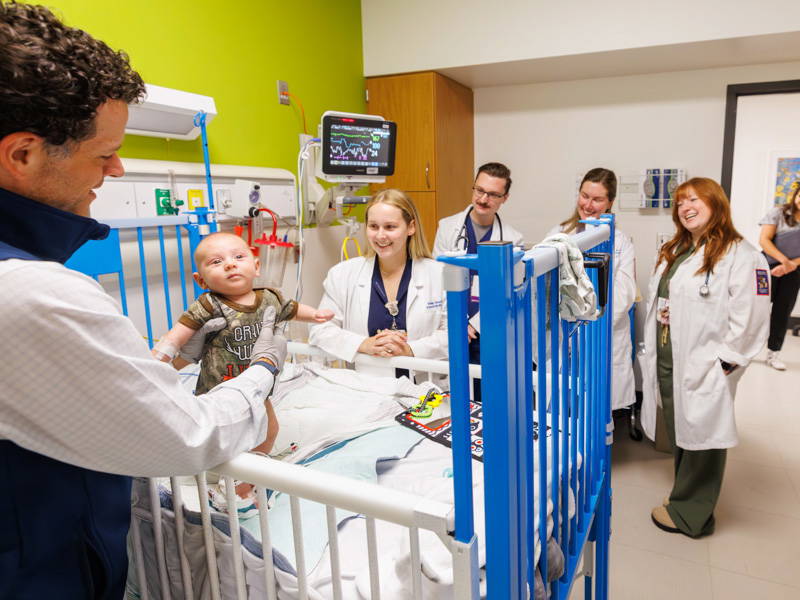
Hobbs evaluates Maverick during morning rounds with his team of house officers, residents and medical students.
Hobbs said UMMC has been successful in attracting medical students to pediatrics, but those who wanted to pursue additional training in pediatric hospital medicine have previously needed to leave the state. Establishing the fellowship could help UMMC retain more of those physicians after training.
“If people are from Mississippi and training in Mississippi, they are more likely to establish roots and stay here,” Hobbs said, “and help us continue our mission to serve the kids of Mississippi.”
Hobbs hopes graduates will leave the program as confident clinician-educators who become leaders and advocates for children while finding new ways to improve pediatric inpatient care.
The fellowship comes as Phillips and the hospital medicine team are already considering how the division can continue expanding its role. Possibilities include additional co-management partnerships with pediatric subspecialists, expanded hospitalist coverage within the children’s hospital and, eventually, opportunities to provide hospital medicine services at other locations around the state.
For Phillips, that growth is grounded in the same mission that has shaped the division to this point.
“There is not a day at the hospital that I leave that I’m not just so grateful for the opportunity to care for the pediatric patients in the state,” Phillips said. “It is just a wonderful place to work, and we have such tremendous support from Dr. Taylor, who I really feel has helped with the growth of not only the hospitalist group but Children’s in general.”