
By: Marilyn Tinnin, Magnolia Tribune

(Photo from MS Department of Archives and History)
Few Mississippi artists have contributed more to Mississippi’s art community than the late Marie Hull. She blended strong color and free expression yet maintained order and balance. Many students learned from her and later contributed to Mississippi’s artistic culture. Marie Hull is forever a Mississippi treasure. She won acclaim in exhibits from Chicago and New York to Paris. From the day she picked up a paintbrush, she was fiercely devoted to filling her life and the lives of others with beauty.
Born in McComb on September 28, 1890, Marie Hull transformed Mississippi’s art scene as both teacher and artist. Throughout her life, her desire to learn remained strong; she explored new ideas until a stroke two weeks before her death in November 1980. As she reflected on her journey, she explained that she intentionally avoided limiting herself to just one style.
“I wouldn’t want to pin myself down to one type of painting. If an artist does that, they get in a Rut.”
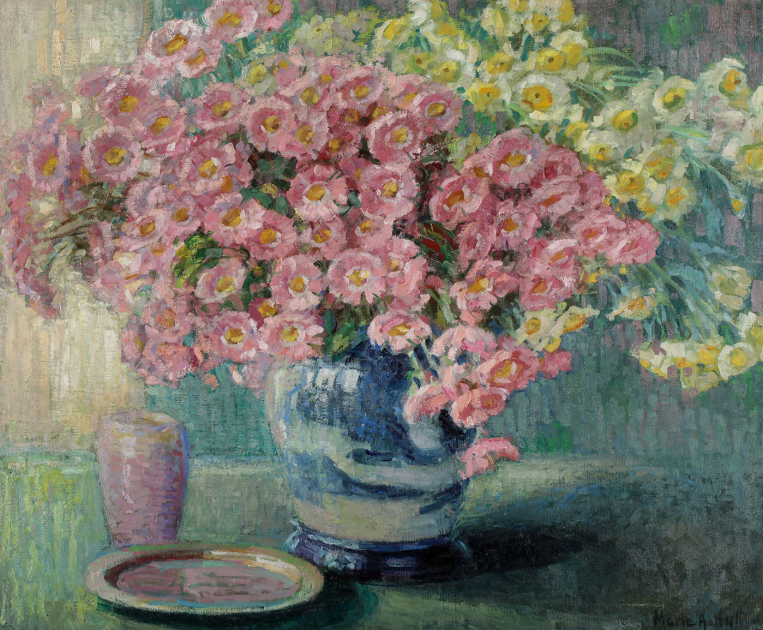
Building on her commitment to beauty and dedication to her craft, Marie Hull was determined, free-spirited, and never afraid to chart her own course. Beyond her artistry, she possessed an energetic presence. One student spoke of the “fear of the turpentine rag.” He said when she did not approve of a student’s work, she would hand him the rag and instruct him to erase the paint and start over. That same student also said her criticism, though sharp, was never humiliating. He described her as “rawhide tempered with sweetness.”
Her original career after graduating from Belhaven College (as it was known at the time) in 1909 was teaching piano and serving as organist for several local congregations in the capital city. Out of curiosity, she began art lessons with local artist Aileen Phillips in 1911, during a period when Jackson’s art scene offered few opportunities for serious study. Seeking further growth, Marie pursued advanced training elsewhere: a semester at the Pennsylvania Institute of Art, followed by studies at The Colorado Springs Art Center, The Art Students League in New York, and abroad in France, Spain, and Morocco. Over the next 60 years, she continued to learn and teach. To Mrs. Hull, there was always more to know and more to explore.
Dr. Louis Dollarhide, longtime “Of Art and Artists” columnist for The Clarion Ledger, wrote in 1966 that he had helped select several of her paintings for the Mississippi Art Association’s spring Garden Party exhibit. After perusing hundreds of works throughout her home, he was struck by her command of technique across styles and decades—Realism, Impressionism, and Contemporary Abstract, all executed masterfully. At 76, after 50 years of work and study, Marie Hull showed no signs of slowing down or ceasing to experiment.
Her daily routines reflected her dedication to her craft. She often did her best painting between 4:00 a.m. and noon, and sometimes painted up to 16 hours a day. When she wasn’t painting, she taught lessons on her front porch at 825 Belhaven Street, where artists like Andrew Bucci and Bill Dunlap began their careers.
Those who knew her best loved to share stories about the Mississippi legend. This admiration was shaped as much by her dynamic presence as by her creative output. Hull’s soft Southern accent veiled a strong, passionate personality that revealed itself in her art and color choices. Candid tributes from students and critics in the 1966 documentary Mississippi Masters: Marie Hull, Her Changing Canvas testify to her unique, larger-than-life presence.
Marie married architect Emmett Hull in 1917. When the Great Depression later halted construction and left Emmett with little work, Marie’s work with the Works Progress Administration’s Federal Art Project supported them.
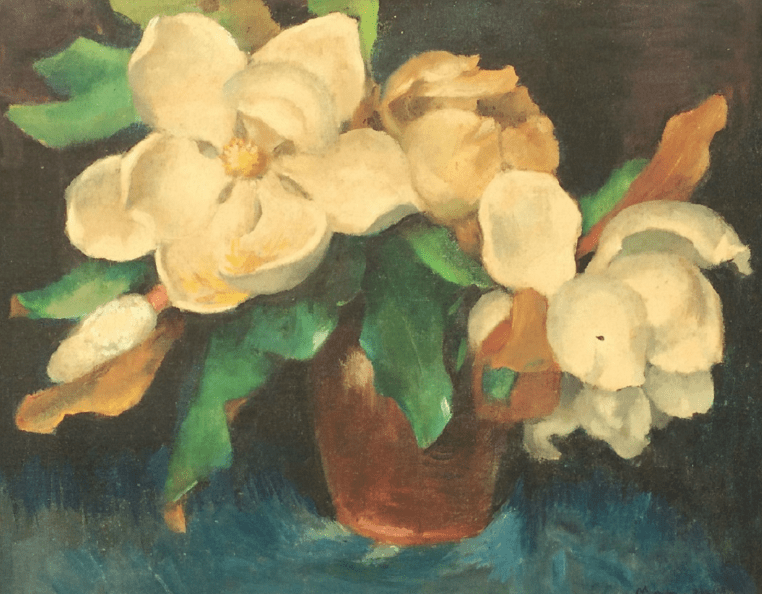
She faced those years with humor and resilience, recalling in a 1966 documentary interview that although serious artists frequently ridiculed amateurs for painting magnolias, she could never criticize anyone for doing so.
“Magnolias saved my life during the Depression! I painted a lot of them,” she laughed.
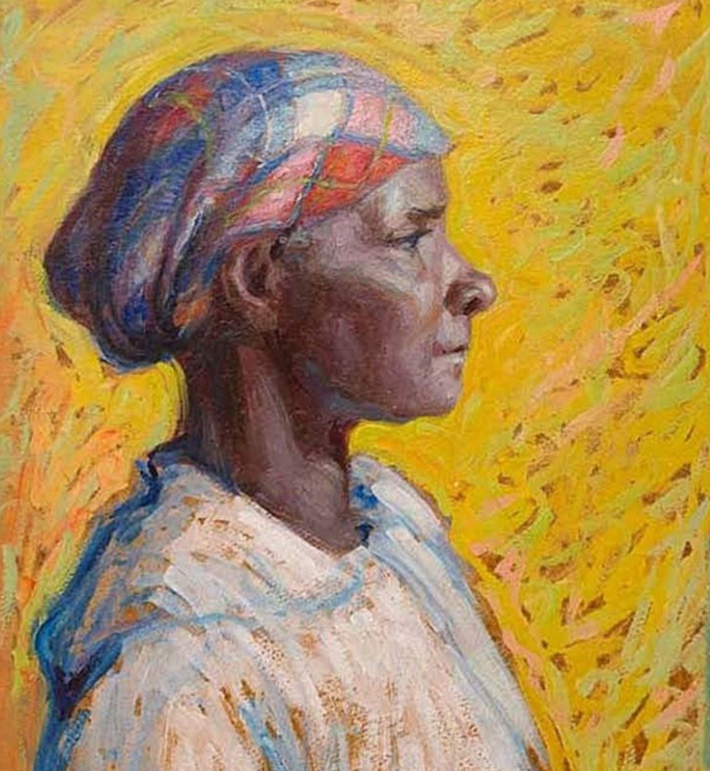
During that period, she also painted portraits that became the “Sharecropper” series. Though their names are unknown, Hull’s brushstrokes captured the dignity, character, hardship, and timeless beauty of her subjects’ faces. Those portraits are indeed poignant stories that do not need words to convey their message.
The Depression left an indelible impression upon her. Like many of that generation, she could “squeeze a dollar until it squealed!” When the financial crunch eased, and she could once again pursue her art exploration travels, she frequently took the train to places she thought she might want to paint. She traveled lightly, taking a sketch pad, a camera, a few dollars, and packed everything, including an egg sandwich, in a paper grocery bag.
The oft-told story goes that she once ran out of money in Kansas City, went to a bank there, and asked to see the President. She explained that she was Marie Hull from Jackson, Mississippi, and wanted to borrow some money. Giving the man her references, she invited him to call the Governor, the Mayor of Jackson, and her bank in Jackson. The Kansas City Banker asked how much she needed to borrow. Mrs. Hull said, “I think five dollars would be enough.” She got the unsecured loan with no problem.
Marie Hull died at age 90 at Compere Nursing Home in Jackson, near the home her husband built for her in 1917. She never sold that house, even after making the nursing home her residence. In her final years, she would often return to paint on its porch on lazy afternoons. Throughout her adult life, Hull focused on developing her talent and deepening others’ appreciation of fine art, especially in Mississippi. Her lifelong dedication left a lasting mark on the state’s cultural landscape.
Governor Bill Waller named October 22, 1975, Marie Hull Day in Mississippi. Two delightful books on the artist are The Art of Marie Hull, by Malcolm M. Norwood, Virginia McGehee Elias, and William S. Haynie; and Bright Fields: the Mastery of Marie Hull by Bruce Levingston. Both are published by the University Press. Though out of print, I found copies online.
It is worth a field trip to the Mississippi Museum of Art to view its large repository of her works in its permanent collection.