

By Roscoe Barnes III, Ph.D., Visit Natchez
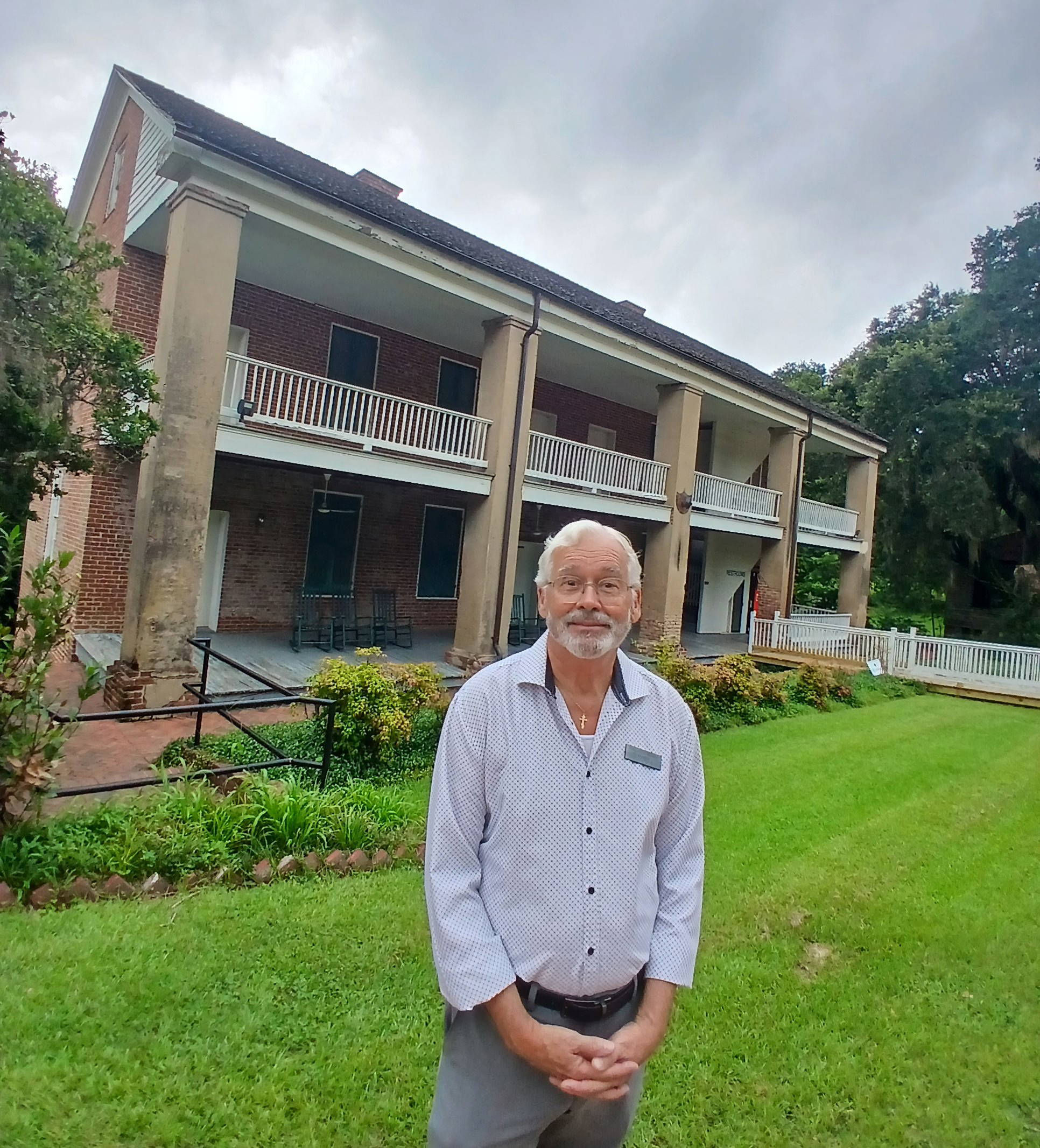
Douglas Lanfear, a docent at Longwood, stands in front of the historic quarters where enslaved families once lived. A first-floor room in the building will be used to interpret and present the history of those families.
The Pilgrimage Garden Club is transforming a first-floor room in the historic quarters at Longwood, where enslaved people once lived, into an interpretive space exploring the lives of enslaved families. The room is being refurbished with period furniture and artifacts to reflect its 19th-century setting.
“We are presenting a room that we think would have been appropriate at that time,” said Dr. Terrel Williams, president of the Pilgrimage Garden Club. He said the ultimate goal is to recognize the enslaved families who lived and worked on the Longwood property by bringing their history to life in this space.
“We’re presenting this exhibit so we can have a better discussion and understand the fact that there were enslaved people living at Longwood who helped build this great monument and played an important role in the lives of the Nutt family,” Williams said.
The exhibit will open to the public on Saturday, September 26, when the Pilgrimage Garden Club holds its symposium on cotton and the dependency (historic quarters) at Longwood. The symposium will be held at the Carriage House.
Little is known about the enslaved families who lived on the property. Club members hope the new interpretive space will help broaden public understanding of the lives of the enslaved people whose labor was central to the Longwood estate.
Mimi Miller, executive director emerita of Historic Natchez Foundation, described the quarters as a two-story brick building with gable roof and full-width, double-tiered gallery. She said it is one of the largest known structures in the Natchez District used to house enslaved people.
The brick structure, which dates to about 1830 or earlier, is located about 100 feet northwest of the Longwood mansion. It was likely enhanced or expanded between 1860 and 1861, according to the National Park Service.
The quarters are one of several historic outbuildings on the property. The others include a frame carriage house, a dilapidated one-story frame building north of the quarters and a deteriorated frame kitchen building.
Longwood is located at 140 Lower Woodville Road. It is a well-known historic site in Natchez that is recognized as the largest octagonal home in the United States. It was owned by Haller Nutt, a Unionist, and his wife, Julia. Philadelphia architect Samuel Sloan designed the building to have 32 rooms.
Longwood sits on 86 acres of property purchased by Haller Nutt in 1850.
Haller Nutt was one of the wealthiest cotton planters in the Antebellum South. Over his lifetime, according to Williams and historian D. Clayton James, he owned 800 enslaved people and 42,947 acres on 21 plantations stretching from Adams County, Mississippi, to Terrebonne Parish, Louisiana.
Longwood’s construction began in 1860. During this time, Haller Nutt and his family lived in the quarters temporarily while Longwood was under construction, sharing the building with enslaved families until the basement level of the mansion was completed, according to Williams.
When the Civil War broke out in April 1861, it halted construction. The northern artisans and craftsmen dropped their tools and returned to the North. They left the upper floors of the house an empty shell, according to some reports. Many enslaved people remained on the property and continued labor on the construction, according to the National Park Service.
Only the outside of the building and nine rooms in the basement area were completed. The Nutt family moved into the completed area on the basement level of the mansion in 1862.
On June 15, 1864, Haller Nutt died of pneumonia at the age of 48. His family continued living in the house even though its construction was never finished.
“It never became what it was supposed to become,” said Miller.
In 1866, thousands of newly freed African Americans visited Longwood for a Fourth of July celebration and picnic.