
By Meredith Biesinger, Magnolia Tribune
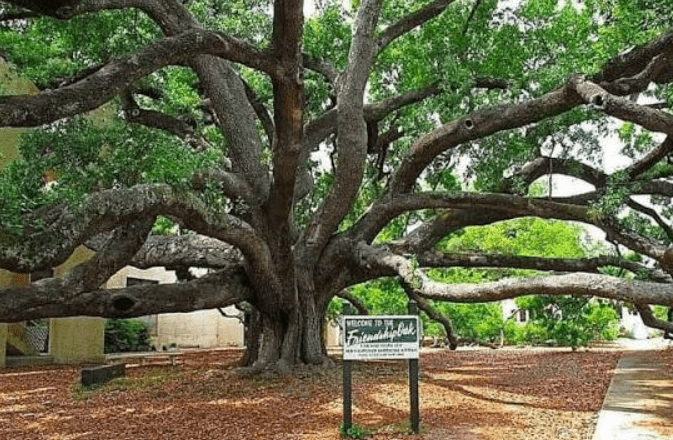
(From Mississippi Memories)
Have you ever stood beneath something older than America?
On the campus of the University of Southern Mississippi’s Gulf Park in Long Beach, you can do exactly that. Rising from the front lawn overlooking the Gulf of Mexico is one of Mississippi’s most beloved living landmarks — a sprawling live oak that has quietly watched more than five centuries of Gulf Coast history unfold.
It’s called the Friendship Oak.
The first time you see it, you quickly realize why it has become one of the most photographed spots on the Mississippi Gulf Coast. Its branches reach in every direction, and the wide canopy offers the feeling of stepping into a cool, shaded outdoor room.
Stand there for a minute, and it’s hard not to think about just how long that tree has been part of this landscape.
Historians estimate that the Friendship Oak first began growing around 1487. That means the tree was already alive when Christopher Columbus sailed to the Americas. By the time Spanish explorer Ponce de León arrived in Florida searching for the Fountain of Youth, the young oak had already begun producing acorns.
Mississippi wasn’t a state yet. Much of the Gulf Coast was still untouched shoreline and dense forest.
But this tree was already here.
Over the centuries, as time moved forward, the Friendship Oak has quietly watched the Mississippi coastline change around it. Ships once moved through the nearby Gulf waters, including vessels tied to the colorful pirate lore that still echoes along the coast today. Communities slowly grew along the shoreline, families built homes, and generations of Mississippians began creating the traditions and culture that make the Gulf Coast such a special place.
Through it all, the oak kept doing what old live oaks do best — spreading its branches, digging its roots deeper, and standing steady.
Today, the Friendship Oak rises about 59 feet tall, but its real presence comes from its reach. The canopy stretches more than 150 feet across, with massive limbs extending outward in long, graceful arcs, some reaching more than 60 feet from the trunk and casting nearly 16,000 square feet of shade beneath.
It doesn’t take long to understand why people naturally gather there.
The oak sits on what was once the campus of Gulf Park College for Women, and former students still talk about spending time beneath its branches — studying, talking with friends, or simply enjoying the breeze coming in from the Gulf. Over the years, the tree also became a favorite place for weddings, with couples exchanging vows beneath its sweeping canopy.
At the base of the tree, a small marker shares the words that helped give the oak its name:
“I am called the Friendship Oak. Those who enter my shadow will remain friends through all their lifetime.”
Whether you believe the legend or not, it’s easy to see how the tree came to be associated with connection and memory. Places like this tend to gather stories over time.
Like most things along the Mississippi Gulf Coast, the Friendship Oak has weathered its share of storms. Hurricanes have rolled in from the Gulf for centuries, reshaping the coastline again and again. Yet the oak has remained standing through them all.
Even Hurricane Katrina, which forever changed so much of the coast in 2005, could not take it down.
In 2017, the tree lost a large section during a storm, something deeply felt by many people connected to the campus. But like so much of the Gulf Coast itself, the Friendship Oak endured. Today, its branches still stretch wide across the lawn, a quiet reminder of the resilience that runs deep in this part of Mississippi.
Students at Southern Miss Gulf Park continue to study the tree as part of their coursework, measuring it each year and documenting how it changes over time. Rather than drilling into the tree to determine its exact age, they focus on observing and preserving it — helping make sure this living piece of Mississippi history remains for future generations.
But the numbers only tell part of the story.
What really makes the Friendship Oak special is the way it draws people in today. Visitors wander over while exploring the campus. Photographers set up beneath the branches. Families stop to take pictures. And almost everyone who stands under it eventually looks up, taking in the size and age of something that has been here for more than 500 years.
Mississippi has a way of holding on to places like this — places where history and landscape meet in quiet, meaningful ways.
The Friendship Oak has watched over the Gulf Coast since the late 1400s. It has seen storms, weddings, students, and countless visitors pause beneath its branches.
And if you ever find yourself in Long Beach, it’s worth stepping into that shade for a minute.
Because some Mississippi stories don’t just live in history books.
Sometimes, they’re still growing.